
Bangkok Layover Guide - the Train Makes It Work
Bangkok has something the Gulf hubs do not: a train from the airport that beats the traffic. That single fact is what makes a short Bangkok layover workable when a short Dubai one is not.
The train is the whole point
Every layover guide on this site does the same arithmetic: can you clear immigration, get into the city, do a thing, get back and clear security again with a buffer?
At the Gulf hubs the answer is eight hours minimum, because everything depends on a taxi and a motorway.
Bangkok is different, and the reason is the Airport Rail Link. A train from Suvarnabhumi into the city, roughly half an hour, costing very little, and it does not sit in traffic.
That matters more here than almost anywhere, because Bangkok's traffic is genuinely severe. A journey that looks like twenty minutes on a map can take an hour at the wrong time of day. The train ignores all of it, and it turns a six-hour layover from a bad idea into a good one.
Visitors default to taxis, because that is what you do at an airport, and then they run out of time and blame the city. Ask us to price a Bangkok stopover.
Under six hours: stay airside
Even with the train, under about six hours the maths does not close.
Suvarnabhumi is a big building with long concourses, so budget real time for the walk at both ends. The lounges are decent rather than exceptional, which is the honest assessment: this is not Doha, where the lounge is a destination.
Eat airside, walk around, and accept it. There is no shame in a layover being a layover.
Six to nine hours: go and eat
This is the sweet spot, and the answer is not a temple.
Take the train in. Eat, properly, for two hours. Take the train back.
That sounds underwhelming and it is the best layover available in Asia. Bangkok has the best street food on earth, and it is fifteen minutes from a station: a plastic stool, a cart, boat noodles or som tam or a pork skewer, and something cold. Then another one.
You have flown a long way and you are going to fly further. A proper meal in a real city beats a hurried photograph of a monument you did not have time to understand.
If you want a sight with it, Wat Arun across the river at dusk is the one, because the river is itself the pleasure and the boat is the transport. Our things to do in Bangkok page covers what is worth booking properly.
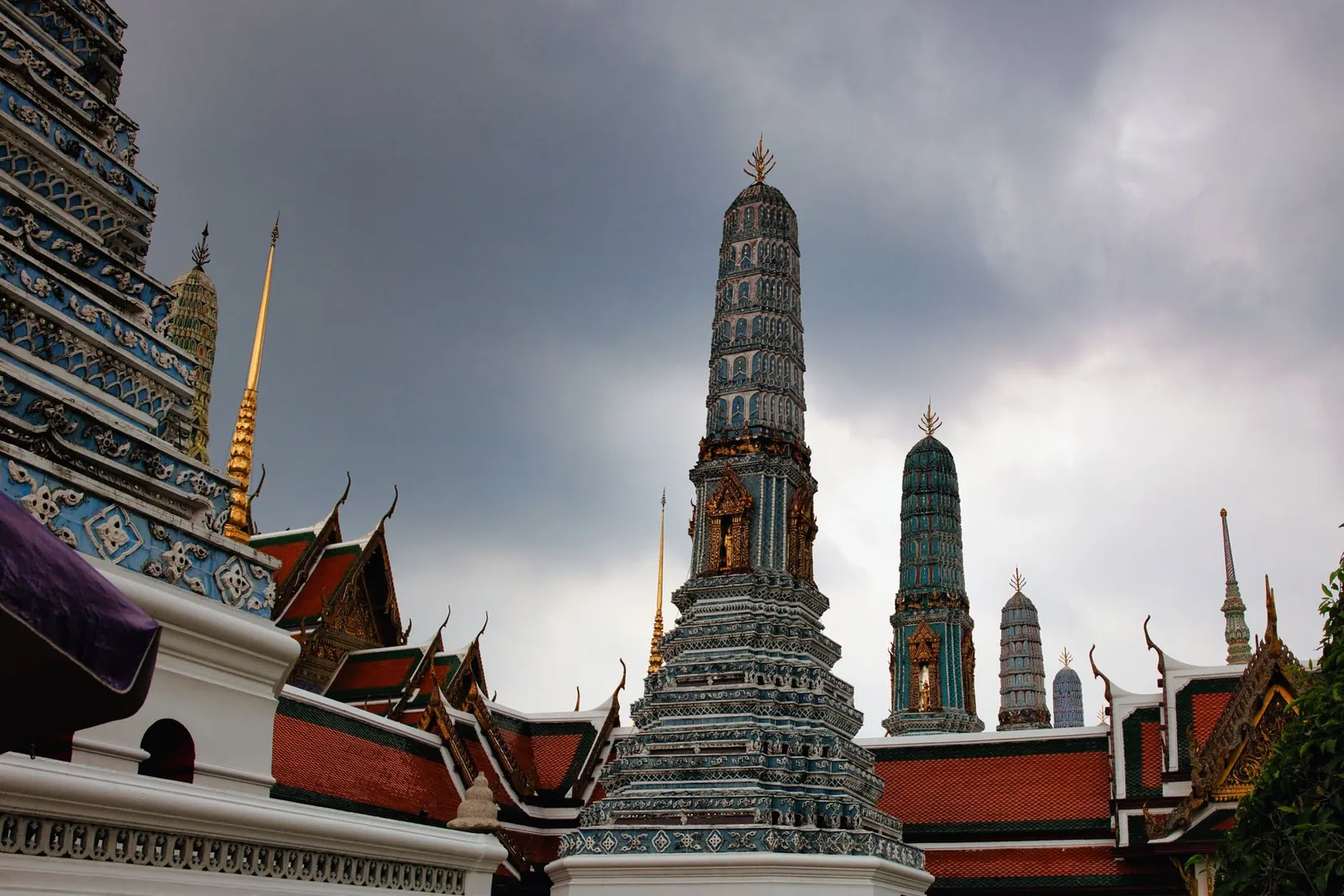
What we would not do: the Grand Palace on a six-hour layover. It is worth two hours and a dress code and a queue, and doing it against a clock is how people miss flights.
The two-airport trap
This is the practical warning and it is the thing that actually ruins Bangkok connections.
Bangkok has Suvarnabhumi and Don Mueang, and they are a long way apart.
Everything full-service from Australia lands at Suvarnabhumi. Don Mueang is the low-cost base and handles a great deal of regional and domestic flying. If your onward flight to Phuket, Krabi, Chiang Mai or elsewhere in the region leaves from the other airport, getting between them is a cross-city journey through the traffic described above.
That is not a connection. That is an expedition, and a flight search will happily sell you a two-hour version of it on separate tickets and take no responsibility when it fails.
Two habits fix it. Check which airport the onward flight uses before you book anything. And where the fares allow, let us ticket the whole journey together so the airline owns the connection, the bags stay checked and a late arrival becomes their problem. Our flights to Thailand page covers the corridor and our Phuket guide is honest about the distances at the far end.
Two nights: the version worth booking
A stopover of two or three nights on a through fare to Europe or India frequently costs little or nothing extra.
Bangkok sits roughly halfway to Europe and directly on the way to a great deal of Asia, which is exactly why our Melbourne to Bangkok page argues that the smartest booking on that route is often not to go to Bangkok at all, but to go through it.
So the same three days can either be a holiday you paid a full return airfare for, or a nearly free interval that converts one brutal journey into two civil ones. That is not a marginal improvement.
Two days does the stopover version properly: the food, one temple cluster, a river trip, and a night market. Our Bangkok travel guide covers the city.
Where you sleep decides how much of that you actually get, because Bangkok traffic is the tax on every plan. Riverside puts you on the boats, which is the one form of transport the traffic cannot touch, and it is the choice we push for a short stop. Sukhumvit along the BTS line is the pragmatic option and where the serviced apartments are if you are staying three nights or more. Silom sits between the two and is quieter at night than its reputation suggests. A room near Suvarnabhumi only makes sense if you are leaving before dawn. Check Bangkok hotel rates
If the stopover stretches to four nights, the domestic hop north or south is cheap and changes the trip entirely: Chiang Mai for temples and mountains, Krabi or Koh Samui for the coast. See Chiang Mai stays or compare Krabi rates, then ask us to add the domestic sector to the quote rather than booking it separately.
Which sector to put the good seat on
A useful thing to know if Bangkok is your hub rather than your destination.
Put the premium cabin on the sector after Bangkok, not before it. That is the long leg, that is the one with a day waiting at the end, and it is frequently cheaper to build it that way round.
Australians instinctively buy the flat bed on the first leg because it is the one they are thinking about when they book. It is usually the wrong one. Our is business class worth it guide sets out the general principle: the right question is never which leg is longest, it is which leg has a day waiting at the end of it.
Practical bits
Take the train. Both ways. This is the whole page.
Do not attempt the Grand Palace against a clock.
Suvarnabhumi is big. Even a same-airport connection deserves more than the minimum on the screen.
The wet season is fine for a layover. June to October means a heavy afternoon downpour and sunshine either side of it. Plan the middle of the day indoors, which is what the city does anyway.
March to May is genuinely hot, in a humid, heavy way that makes walking around the old city an endurance exercise. In those months, eat in air conditioning.
Six months of passport validity, as everywhere.
The honest summary
Under six hours: stay airside. It is a layover, not an opportunity.
Six to nine: the train, and eat. Best layover in Asia and the one nobody books.
Two nights on a Europe or India trip: frequently nearly free and worth every hour.
Connecting to Phuket or Chiang Mai: check which airport, on one ticket, before anything else.
The decision is made at the booking rather than at the airport, which is exactly why it is worth asking. Get a free quote with the stopover priced.