
Top 10 Things to Do in Kochi - Fort Kochi and Kathakali
Kochi is where nearly every Kerala trip begins, and the mistake is treating it as the airport with a fort attached. Ten things worth your time, and the backwater decision that matters more than all of them.
Kochi is not the airport with a fort attached
It gets treated that way. Land, sleep, drive south to a houseboat, and the peninsula that half the world fought over for four hundred years gets an afternoon.
Fort Kochi is the most unusual small place in India. The Portuguese, the Dutch and the British all held it; Arab, Chinese and Jewish traders were here long before any of them; and unlike almost everywhere else with that history, the layers are still standing next to each other rather than under a shopping centre. It is walkable, it is shaded, it is quiet after dark, and it is the gentlest possible landing after twelve hours in the air.
Give it two days. Then go south. Get a Kochi fare quote.
The ten
1. The Kathakali makeup, an hour before the Kathakali
Everyone books the performance. The people who enjoy it book the makeup.
At the dedicated cultural centres you can sit and watch the transformation happen: rice paste built up in ridges along the jaw, colour applied in a code that tells the audience who is noble and who is a demon before a single gesture, and a performer receding behind it over an hour or more.
Then the play, which is told entirely in eye movements and hand shapes, with the vocabulary explained beforehand. Once you know that the eyes are doing the talking, it stops being baffling and starts being extraordinary. Compare Kathakali experiences on Viator.
2. The Chinese fishing nets, honestly described
The cantilevered nets on the Fort Kochi shoreline are the postcard, and they need an honest caption.
They are real, they are old, they work, and a team of men still lowers and raises them with counterweights and shouting. They are also, these days, mostly kept going for the people watching rather than the fish, and the catch is thin. Go at sunset anyway, because the silhouettes against that harbour are genuinely lovely, and because the men will invite you to pull on the rope, which you should.
3. The Paradesi Synagogue, and Jew Town around it
Down in Mattancherry, at the end of a lane of antique shops, sits one of the oldest synagogues in this part of the world, and the detail people remember is the floor: hundreds of hand-painted blue and white Chinese tiles, no two the same, carried here by ship centuries ago.
The community that built it has almost entirely gone, which makes the building quiet in a way that is hard to describe. It closes on Saturdays and Jewish holidays. The lane leading to it is the best antique browsing in Kerala.
4. St Francis Church, and an empty grave
The oldest European-built church in India, and Vasco da Gama was buried in it.
He is not there now; his remains were taken to Lisbon some years after, and what is left is the marked spot in the floor and a rather plain, rather moving colonial church with punkah fans still strung above the pews. Five minutes, no ticket, and one of the strangest footnotes in Indian history.
5. The spice warehouses of Mattancherry
Follow your nose off the tourist lane and into the working streets behind it, where the godowns are still doing what this coast has done for two thousand years: sorting, drying, weighing and shipping pepper, cardamom, ginger and cloves.
It is not a sight, it is an atmosphere, and it is why the Portuguese sailed here in the first place. Pepper made this town, and the town still smells of it.
6. The harbour ferry
The best public transport in India, and it costs almost nothing.
Small passenger ferries cross between Fort Kochi, Vypin, Willingdon Island and Ernakulam all day. You get a working harbour, container ships, a breeze, ten minutes of sitting down, and the whole geography of the place explained without a word. Take one you do not need.
7. Kalaripayattu
One of the oldest martial arts anywhere, from this state, and the demonstrations are staged for visitors without being fake.
Bodies going through the air, staffs, flexible swords, and a quantity of fire that would not be permitted at home. It runs about an hour, it is loud, and it pairs well with a Kathakali night on your other evening. Find Kochi experiences on Klook.
8. A sadya on a banana leaf
Rice in the middle, a leaf, and a procession of small vegetarian dishes laid around it in an order that is not random and that someone will correct you on. Eaten with your right hand, folded at the end (fold it towards you if you enjoyed it).
Kerala's food is coconut, curry leaf, mustard seed and sourness rather than the heat and cream people expect from India. A sadya is the clearest possible introduction to it, and a toddy shop lunch, rougher and fierier, is the other side of the same cuisine.
9. The Biennale, if your dates land on it
Fort Kochi hosts a contemporary art biennale across the town's old warehouses, and it is the largest exhibition of its kind in South Asia.
When it runs, it takes over the peninsula: spice godowns become galleries, the population of the town changes, and the whole place is worth an extra two days. When it does not, none of that exists. Check before you build a trip around it, and book accommodation early if it is on, because Fort Kochi is small and it fills.
10. A canoe through the narrow canals
The backwater trip that is actually worth doing, and the one least often booked. See the next section, because this is the decision that shapes your Kerala week. See backwater canoe tours on Viator.
The houseboat question, answered honestly
This is the thing everyone books and the thing most often mildly regretted.
The overnight houseboat at Alappuzha is the famous one. A converted rice barge, a bedroom, a cook, a slow evening, a sunset. It is genuinely pleasant. But there are an enormous number of them now, the large ones draw too much water to enter the small canals, and so they spend the day out on the wide lake sections, where the view is water and distant palms and the boat in front of you.
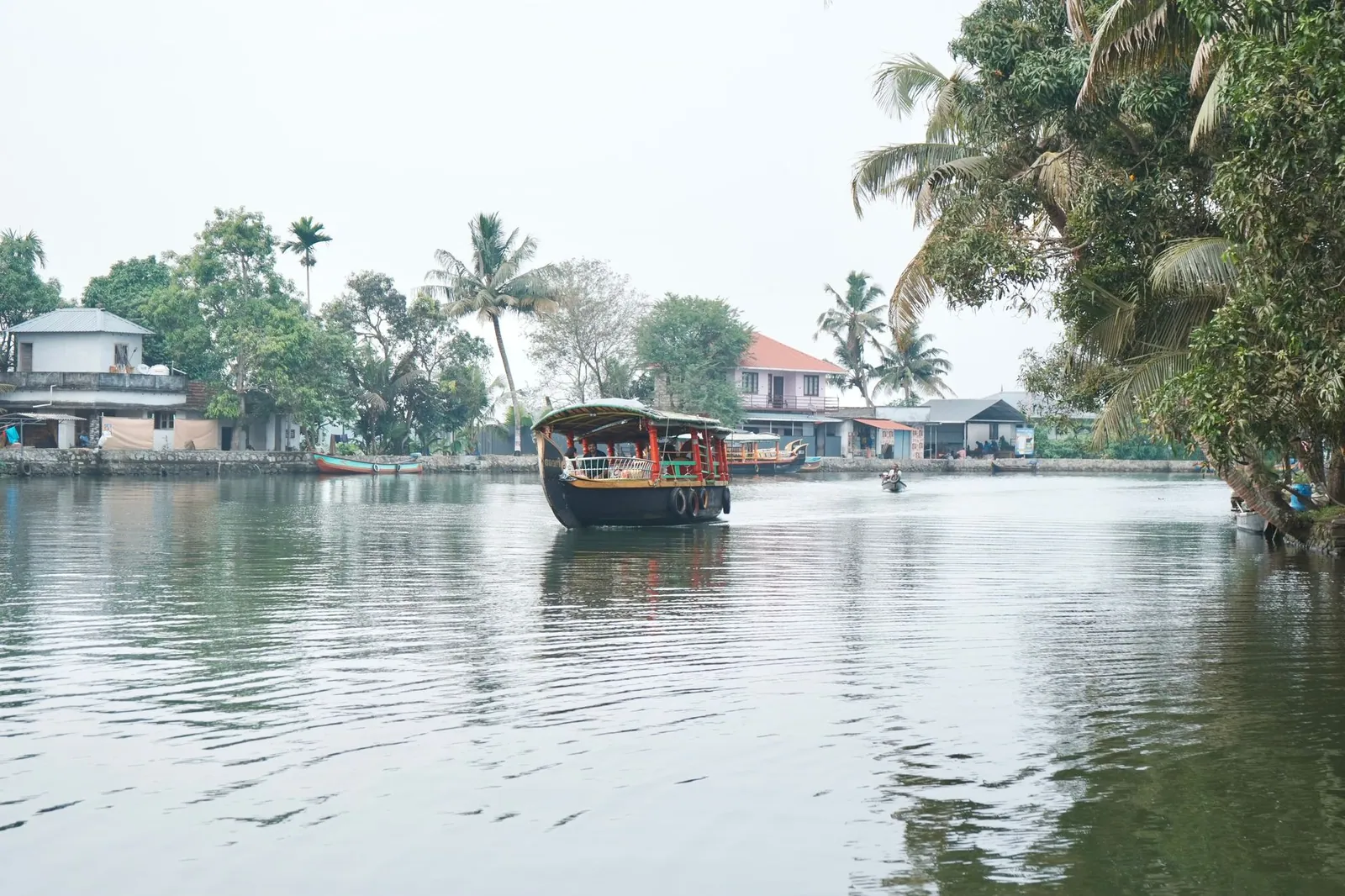
A day canoe or small punted boat goes where the houseboats cannot: canals two boats wide, past houses, ducks, women washing clothes, children going to school by ferry, toddy tappers up the palms. This is the backwaters as a place where several million people live, rather than as a cruise.
A shikara, the small motorboat, is the compromise: more range than a canoe, more access than a barge.
Our advice to most first-time visitors: do the canoe, and add a houseboat night only if a night on a boat is itself the appeal. Nobody who has done the canals in a canoe has told us they wished they had been on a bigger boat.
Three days, shaped
Day one, Fort Kochi on foot. St Francis Church, the nets at some point, the ferry for no reason, and Kathakali in the evening with the makeup from the start.
Day two, Mattancherry. The synagogue and the lane of antique shops in the morning while it is cool, the spice streets behind it, a sadya for lunch, the Dutch Palace murals in the afternoon, and Kalaripayattu at dusk.
Day three, the water. A canoe through the village canals, ideally starting early enough to be out before the heat. Then either back to Fort Kochi, or onward: the tea country around Munnar is a few hours east and a different climate entirely, and the southern backwaters and beaches are a few hours down the coast.
Two experiences a day is the honest maximum here. Kerala's whole argument is that you should slow down; taking that advice is the point of coming.
The monsoon gets here first
The southwest monsoon makes landfall on this coast before it reaches anywhere else in India, which makes Kerala the country's first wet place each year and gives Kochi a genuinely dramatic season.
For most visitors that means October to March: dry, warm, everything open. April and May are hot and heavy without the relief of rain. From June the rain is serious, the backwaters swell, the greens are absurd, the prices fall and the Ayurvedic clinics fill up, because the tradition holds that the humid season is when treatment works best. That is a real and long-standing local view rather than marketing, and it is why the monsoon here has an audience that the monsoon elsewhere does not.
The full season detail sits on our Kochi travel guide, and the flight timing that determines your first day is on the Sydney to Kochi flights page. Ask us to check your Kerala dates.
Booking notes
Prices shown by our partners are live and in your choice of currency, most activities confirm instantly, and free cancellation windows are stated on each listing. Kochi asks for very little planning: the churches, the synagogue, the nets and the ferries are all there when you are. Book ahead for a backwater canoe in the busy months, for anything at all if the Biennale is running, and for Ayurvedic treatment, which starts with a consultation rather than a booking form.