
Kuala Lumpur Travel Guide - Food, Value and KLIA2
Kuala Lumpur is Singapore's food with a third of the price tag and a fraction of the polish, and that trade suits more travellers than admit it. It is also the easiest stopover in Asia, provided you understand which terminal your onward flight leaves from.
The best value city in Asia
Kuala Lumpur does not get the affection it deserves, and the reason is that it sits next door to Singapore.
Both cities are built on the same three cultures. Both eat superbly. One of them is immaculate, efficient, and expensive enough that Australians budget for it. The other is scruffier, hotter, more chaotic, and costs a fraction of it.
Our honest read: for a traveller who wants everything to work, Singapore is the right answer, and our Singapore guide makes that case. For a traveller who wants a city with its clothes off, KL is more fun, and the food is at least as good, because it has the same three culinary traditions with more competition and less regulation. Ask us about Malaysia fares.
Three cuisines and the crashes between them
This is the entire argument for the city, so it goes first.
Malaysia's population is Malay, Chinese and Indian, and in Kuala Lumpur those three cook side by side and constantly borrow from each other. What that produces is not fusion in the restaurant sense; it is a city where three complete cuisines exist at street level and a fourth, Nyonya, grew out of the marriages between two of them centuries ago.
Nasi lemak is the national dish and it is breakfast: coconut rice, a fried anchovy and peanut crunch, cucumber, egg, and a sambal that decides whether the version is good. Eat it from a stall out of a banana leaf parcel, not a plate.
Roti canai is the Indian-Malaysian flatbread, slapped and spun and griddled, served with dhal and curry, and the mamak stalls do it all night for the price of nothing.
Char kway teow is the Chinese-Malaysian noodle standard, and the test is wok hei, the smoky char that a home kitchen cannot produce.
Banana leaf rice is the KL Indian lunch: rice on a leaf, three vegetables, a pappadum, curry poured over it, refills until you fold the leaf.
Satay here is a serious business rather than a bar snack.
Mamak stalls are the institution. Indian-Muslim, open all night, plastic chairs on a footpath, teh tarik pulled theatrically between two cups, and a crowd watching football at three in the morning. It is the single most Malaysian experience available and it costs almost nothing.
The city, honestly ranked
The Batu Caves are the best half-day and one of the easiest day trips in Asia: a commuter train from the central station, half an hour, and you arrive at an enormous limestone outcrop with a giant golden statue at the base and a very long, very steep painted staircase up to a cave temple inside the hill. Go early. The heat is brutal by ten and the monkeys are thieves with no shame.
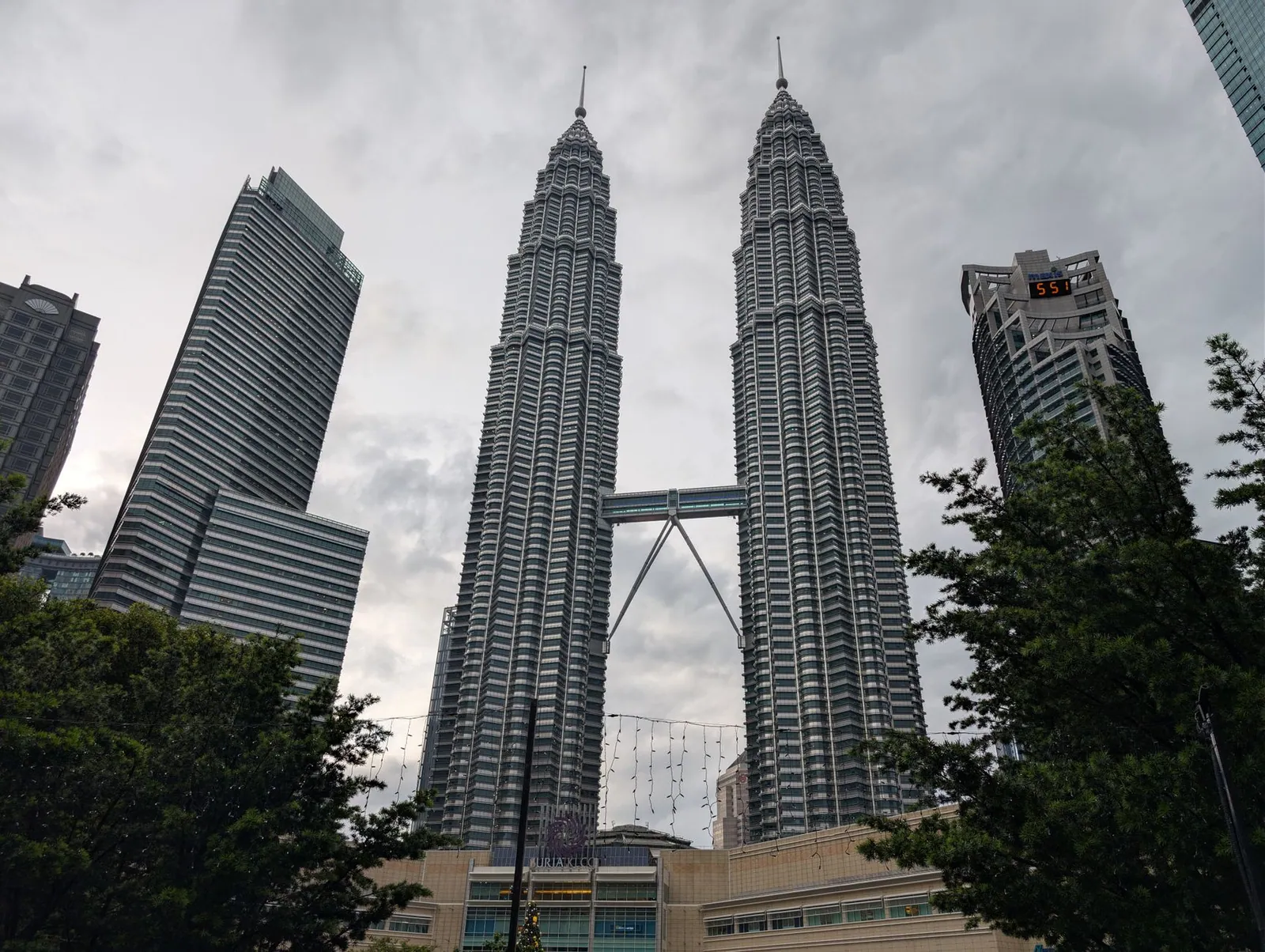
The Petronas Towers are worth going up once, with timed tickets booked in advance because they sell out. The counterintuitive advice: the better experience is looking at them from a rooftop bar in the evening, because they are the thing worth seeing and you cannot see them from inside.
Merdeka Square and the old colonial core hold the Sultan Abdul Samad building and the confluence of two rivers that gives the city its name, which translates roughly as muddy estuary. It takes an hour and it explains where the place came from.
Masjid Jamek and the Masjid Negara are both open to respectful non-Muslim visitors outside prayer times, and robes are provided. The national mosque's roof is a piece of genuinely good modernist architecture.
Chinatown, Petaling Street is a covered market street selling counterfeit everything, and the reason to go is the food around the edges rather than the handbags in the middle.
Brickfields, Little India is louder, brighter and better for lunch.
KL Bird Park is a large walk-in aviary and it is genuinely excellent, which is not a sentence we write often about bird parks. Good for families.
The Islamic Arts Museum is superb and almost empty, which is a common combination in this city.
The airport is a two-terminal problem
This is the practical trap and it catches people constantly.
Kuala Lumpur's airport has two terminals, and they are separate buildings joined by a train rather than a walk. Full-service carriers generally use the main one; the low-cost carriers largely use the other. The train is quick and works well.
The problem is not the train. The problem is what happens when your itinerary is on two separate tickets, which is exactly what a cheap search will hand you: you land, you clear immigration, you collect your bags, you take the train, you check in again from scratch, and you queue through security again. That is a real amount of time, performed by a tired person, and if the first flight is late, the second ticket is simply gone.
Two fixes. Where the fares allow it, we ticket the whole journey together so the airline owns the connection and the bags stay checked through. Where they do not, we build in serious buffer rather than the tightest legal minimum. Our flights to Malaysia page covers the routings and the schedule detail.
Malaysia Airlines via KL is also, frequently, the sharpest premium fare on the India corridor, which is why KL shows up so often in our quotes as a hub rather than a destination. A day or two here on the way through costs little and is a good use of a stopover.
The stopover version
Two days is genuinely enough for the city, which is what makes it such a good stopover.
Day one: the Batu Caves in the morning by train, back for a banana leaf lunch in Brickfields, the Islamic Arts Museum through the hot afternoon, a rooftop bar at dusk looking at the towers, and a mamak stall at midnight.
Day two: the colonial core and Merdeka Square early, Chinatown for lunch, the Bird Park or the towers, and a proper dinner somewhere the city has got excited about.
That is Kuala Lumpur, done properly, and you have had the best of it. Anything beyond three days here should probably be spent somewhere else in Malaysia: Penang for the food and the shophouses, Langkawi for a beach, the Cameron Highlands for tea and a jumper, or Borneo, which is a completely different country in every sense that matters.
The weather, which is the same every day
There is no season here in any useful sense. Kuala Lumpur sits near the equator and it is hot and humid every day of the year, with rain arriving as an intense afternoon downpour rather than a grey day.
March to April and September to November are somewhat wetter. This matters less than you would think, because the pattern is the same: a hot morning, a dramatic burst of rain, and an evening that is pleasant. Plan indoor afternoons, which is what the entire city does, and any month works.
The practical consequence is that KL is one of the few destinations where you can book on price rather than season, which is a rare and underrated luxury.
The bits nobody mentions
The trains work. The commuter rail and the light rail cover most of what a visitor wants, they are cheap, and they are air-conditioned. Visitors default to ride-hailing and then sit in traffic.
Nothing is walkable, and it looks like it should be. The map lies. Distances that appear to be a stroll are a sweaty twenty minutes with no footpath, because the city was built for cars and then apologised for it with covered walkways in some places and not others.
English is everywhere. More than in most of the region, which makes this an unusually easy first Asian trip.
Alcohol is available but taxed heavily. It is not a dry country, but it is a Muslim-majority one, and a beer costs more than the meal it came with. This is the one thing that is not cheap.
Book the arrival night from the night before. Flights from Australia frequently land in the small hours, and a room from the previous evening is the cheapest fix to the worst part of the trip. Get a free Malaysia quote.